
WHY YOUR LIGHTING MATTERS MORE THAN YOU THINK
The Invisible Design Crisis
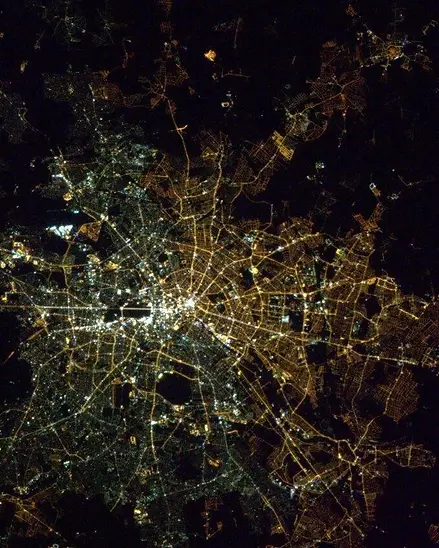
Berlin at night, photographed by Canadian astronaut Chris Hadfield from the ISS, 2013. The stark divide between East Berlin's warmer sodium vapor lighting (yellow) and West Berlin's cooler mercury/halogen standards (white-green) remains visible from space more than two decades after the wall's collapse—a physical manifestation of different design choices.
The transition to LED lighting was supposed to be simple: flip the switch, save energy, problem solved. Instead, cities grew brighter. Homes became harsher. And nobody asked the right question: What kind of light are we creating?
When New York switched to LEDs, the light didn't just change—it transformed. Brighter. Whiter. More pervasive. People complained of headaches. Sleep disrupted. Birds collided with buildings they once navigated safely. The energy was saved, but something essential was lost.
This isn't a story about technology. It's a story about design failure.
The Myth That Still Dominates
"LED means harsh white light. That's the trade-off."
It's wrong. Completely.
This misconception emerged from a technical accident. Early LEDs were limited to cool color temperatures (5000K and above). They were cheap, efficient, and they flooded the market before anyone thought to ask: Should we want this light?
Architects, city planners, and manufacturers made a collective choice—not because it was better, but because it was fast and it was cheap. But LED technology has no inherent relationship to color or quality. The limitation was never the bulb. It was the design.
Understanding What We Can't See: Color Temperature
Imagine two identical rooms. Same brightness. Same furniture. One lit at 2700K, the other at 5000K.
You don't need instruments to feel the difference. One is warm. Inhabitable. The other is sterile. Institutional.
Color temperature measures the hue of light, expressed in Kelvin (K):
-
2700K: Warm, amber-tinted. Candlelight, incandescent bulbs, sunset. This is what humans evolved under.
-
3000K: Warm white. Still approachable. Residential standard.
-
4000K: Neutral white. Commercial spaces, offices. The middle ground.
-
5000K+: Cool white. Daylight-equivalent. Research labs, surgical theaters, interrogation rooms.
The Kelvin temperature isn't about energy use. It's about biology.
Your circadian rhythm—the mechanism that governs sleep, hormone production, and cellular repair—is calibrated to natural light patterns. Warm light in the evening signals: rest. Cool light in the morning signals: wake.
When we flood cities with 5000K+ light at midnight, we're not just illuminating space. We're chemically disrupting every organism that depends on the rhythm of day and night.
And here's what most people don't know: You can have warm light and save energy at the same time.
The Lever Nobody Uses: Intensity
While color temperature gets debated, intensity—the actual brightness of light—is where real design happens.
Intensity is controlled by dimming. And dimming is where LEDs shine.
A traditional incandescent bulb at full brightness consumes its rated wattage. Dim it, and you lose some of that efficiency advantage. LEDs, by contrast, dim smoothly across their full range with minimal energy waste. You can have a 2700K LED at 30% intensity, consuming 30% of its rated energy, with no flicker, no color shift.
This changes everything.
The problem: Most LED installations are set to maximum brightness. Not because the space needs it, but because it's the default.
The design solution: Start with less light, at a warmer color, and let occupants adjust.
A well-designed residential space needs:
-
Evening (20:00-23:00): 2700K, 10-30% intensity. Ambient only.
-
Night (23:00+): 2700K, 5% or off. Emergency lighting if needed.
-
Morning (07:00-09:00): 3000K, ramping to 4000K as the day progresses.
-
Work hours (09:00-17:00): 4000K, 80-100% as needed.
This isn't theoretical. It's implementable with standard LED systems and simple controls.
For commercial and public spaces, the principle is identical: match light to function and time of day, not to the default capacity of the fixture.
The Cost of Carelessness: Light Pollution
If color temperature and intensity are design choices, light pollution is a design failure—and it's expensive.
Outdoor Light Pollution
Every night, artificial light spills upward into the sky. In Berlin, you can see the glow from 50 kilometers away. In major cities, stars disappear entirely.
For wildlife, this is ecological catastrophe:
-
Birds: Artificial light disorients migration patterns. Hundreds of millions of birds collide with illuminated buildings annually because they can't navigate the false signals.
-
Insects: Attracted to light sources, they exhaust themselves, fail to reproduce, and are removed from food chains.
-
Marine life: Turtles, fish, and crustaceans depend on natural light cues for reproduction and feeding. Coastal light pollution has devastated breeding populations.
-
Plants: Flowering and fruiting cycles are disrupted when night length is artificially shortened.
The economic impact is real. Pollinating insects alone provide €580 billion annually in ecosystem services to the EU. We're systematically dismantling the economic foundation of agriculture for the convenience of brighter streets.
And the irony: Most outdoor light is wasted. It spills upward and sideways, illuminating the sky and neighboring properties instead of the ground where it's needed.
A 2019 study of German cities found that 30-50% of outdoor lighting could be eliminated without affecting safety or utility—simply by better design.
Indoor Light Pollution
The problem isn't confined to cities. It's in your bedroom.
Artificial light exposure in the evening suppresses melatonin production by up to 55%. This isn't marginal. This directly impacts:
-
Sleep quality: Shortened sleep duration, fragmented sleep cycles, non-restorative rest.
-
Metabolic health: Disrupted circadian rhythm correlates with obesity, diabetes, and cardiovascular disease.
-
Mental health: Depression, anxiety, and seasonal affective patterns worsen under chronic circadian disruption.
-
Cancer risk: Shift workers and those with severe sleep disruption show elevated rates of certain cancers, likely due to melatonin suppression.
Modern homes compound this. Phone screens at 5000K+. Bedroom ambient lighting left on. Hallway lights at maximum. Street light bleeding through thin curtains.
A well-designed home uses:
-
Warm, dimmable lighting in living spaces, especially after sunset.
-
Blackout capability in bedrooms (or at minimum, warm accent lighting only).
-
No bright screens 60 minutes before bed.
-
Natural light integration during the day to anchor circadian rhythm.
This isn't luxurious. It's foundational to health.
Standards and What They Miss
Germany's DIN EN 12464-1 specifies illuminance (brightness) and color rendering for different spaces. It's necessary. It's not sufficient.
The standard prescribes:
-
Office desk: 500 lux, Ra ≥ 80
-
Living room: 50-150 lux depending on activity
But it says almost nothing about when that light should be delivered, or what color temperature is appropriate for the time of day.
The EU Building Performance Directive (EPBD) mandates energy efficiency standards for new buildings and major renovations. It includes lighting. But it's calibrated toward energy consumption, not occupant wellbeing or ecological impact.
Real standards would integrate:
-
Circadian-responsive lighting: Cool light during work hours, warm light in evenings, darkness at night.
-
Adaptive intensity: Dimming curves that respond to occupancy, time of day, and natural light availability.
-
Light pollution limits: Outdoor spill specifications, time-based controls, species-sensitive wavelengths.
-
Verification protocols: Not just energy modeling, but actual on-site measurement and occupant surveys.
Most European cities lack these entirely. Berlin is better than most—the Lichtverschmutzungsverordnung (Light Pollution Ordinance) in some districts limits spill, but enforcement is weak and the standards are 15 years old.
New York, by contrast, has no municipal light pollution standard. The LED transition happened by market default.
The Design Approach: From Technical to Experiential
Good lighting design starts with a question, not a specification: What is this space for?
A high-end residential project might specify:
-
Living areas: 2700K, dimmable from 5% to 100%, with scene presets for different times of day.
-
Bedrooms: 2700K, max 50% intensity, no light spillage from adjacent spaces.
-
Bathrooms: Flexible. 3000K for morning (alert), 2700K for evening (transitional).
-
Entryways: 3000K, moderate intensity, sufficient for orientation without harshness.
The cost premium over standard lighting is minimal—often 10-15% for hardware and controls. The health and wellbeing return is immeasurable.
For urban spaces:
-
Streets: Shift from 5000K+ to 3000-4000K, reduce overall intensity, implement time-based dimming (brighter 19:00-23:00, dimmer 23:00-06:00).
-
Parks: Minimize upward spill, use 2700K or narrowband amber, design fixtures to prevent light trespass to adjacent properties.
-
Public buildings: Coordinate with adjacent spaces to reduce cumulative light pollution, implement occupancy-based controls.
Berlin's comparison to East Berlin (from space) isn't a story about progress. It's a cautionary tale. The West lit itself brighter without asking what it was losing.
What Happens Next
The technology exists. The standards can be written. The costs are manageable.
What's missing is will. Architects and designers have the responsibility to ask better questions. Planners have the power to enforce standards. Building occupants have the agency to demand better light.
The LED transition gave us an unprecedented opportunity to reimagine how we light the world. Instead, we replicated what we had, just more efficiently. That's not design. That's waste with better intentions.
Real design would acknowledge that light is not a neutral resource to be maximized. It's a force that shapes biology, ecology, and quality of life. The question isn't whether we can afford to design lighting well. The question is whether we can afford not to.
Designing Light for Sustainable, Resilient Cities and Buildings
The transition from conventional to conscious lighting is not optional—it's foundational to urban resilience and building performance in the 21st century. Whether you're planning a residential renovation, a commercial development, or a public space intervention, lighting design must account for energy efficiency, human wellbeing, and ecological impact simultaneously.
HAA&D provides strategic consultation on sustainable lighting design for cities and buildings across Europe. Our approach integrates circadian science, ecological principles, regulatory compliance, and design quality—ensuring that your project not only meets today's standards but anticipates tomorrow's requirements. From concept through specification and on-site verification, we work alongside architects, developers, and urban planners to embed intelligent, resilient lighting systems that enhance both performance and livability.
Real design questions need real expertise. Let's talk about what your project needs.
________________
About this article: This piece draws on research from the Zoological Society London, the German Aerospace Center (DLR), EU Building Performance Directive documentation, DIN EN 12464-1 standards, and circadian biology literature. Specific claims about light pollution impact, energy savings, and regulatory frameworks reflect current standards as of 2025-2026.
HAA&D is an international architecture and design office based in Berlin, specializing in high-end, holistic, sustainable, and minimalist designs. We create bespoke, luxurious spaces tailored to each client's unique vision using the finest materials and meticulous attention to detail.
Contact HAA&D to begin your journey with us.